Baahubali: The Beginning
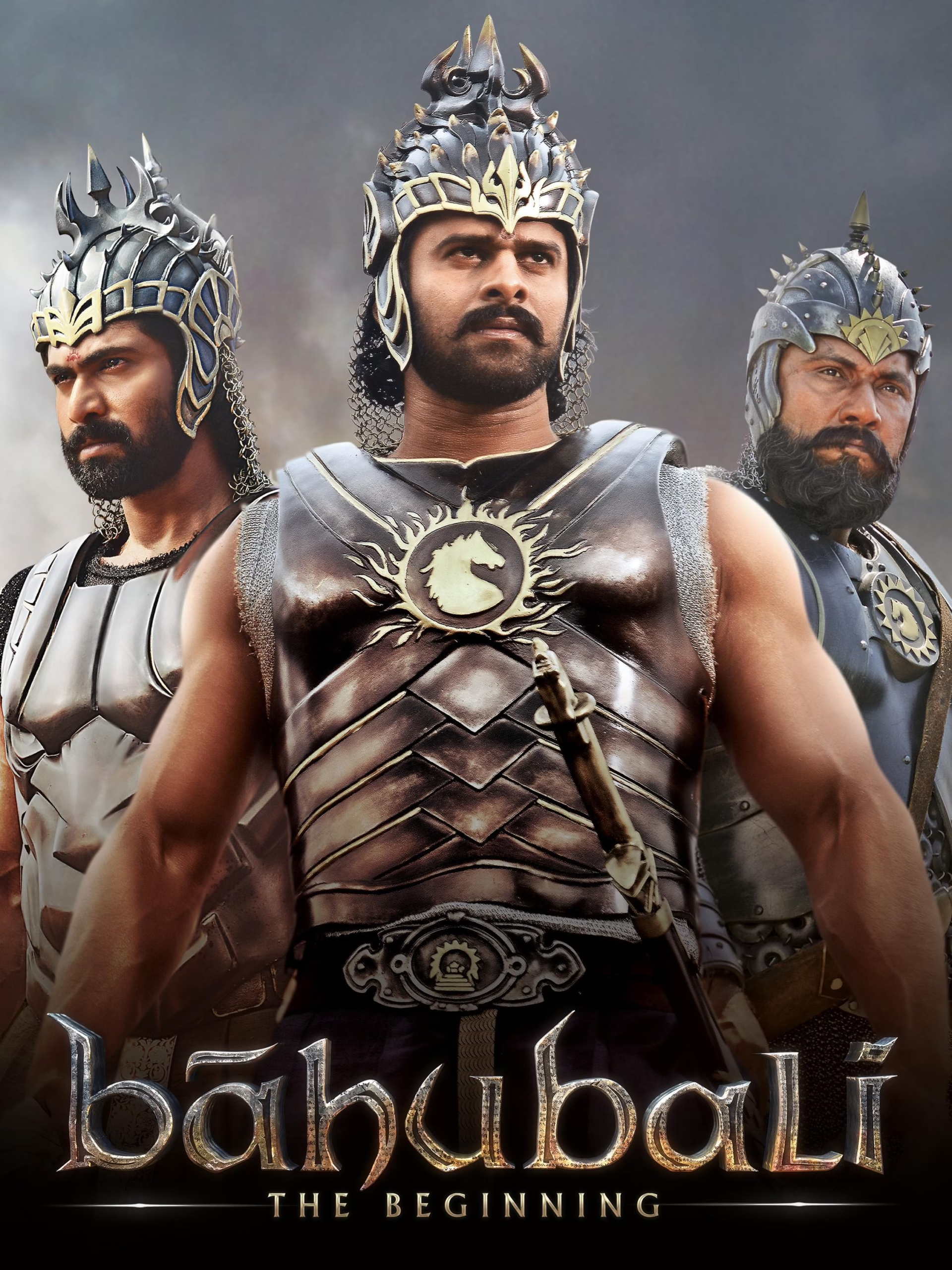
Baahubali: The Beginning is a 2015 Indian epic action film co-written and directed by S. S. Rajamoulhttps://cinemaatlas.com/ss-rajamouli-all-movies-list/i, and produced by Shobu Yarlagadda and Prasad Devineni under the banner of Arka Media Works. Made primarily in the Telugu film industry, the movie was simultaneously shot in both Telugu and Tamil languages.
The film stars Prabhas in a dual role, alongside Rana Daggubati, Anushka Shetty, Tamannaah Bhatia, Ramya Krishnan, Sathyaraj, and Nassar. It is the first part of a two-film series and follows the journey of Sivudu, a brave and curious young man who falls in love with the warrior Avantika and joins her mission to rescue Devasena, a princess imprisoned under the ruthless rule of King Bhallaladeva. The story continues in the sequel Baahubali 2: The Conclusion (2017).
Baahubali: The Beginning
| Field | Details |
|---|---|
| Movie Name | Baahubali: The Beginning |
| Directed by | S. S. Rajamouli |
| Screenplay by | S. S. Rajamouli |
| Story by | V. Vijayendra Prasad |
| Dialogues by | C. H. Vijay Kumar (Telugu), Madhan Karky (Tamil) |
| Produced by | Shobu Yarlagadda, Prasad Devineni |
| Starring | Prabhas, Rana Daggubati, Anushka Shetty, Tamannaah Bhatia, Sathyaraj, Nassar, Ramya Krishna |
| Cinematography | K. K. Senthil Kumar |
| Visual Effects | V. Srinivas Mohan |
| Edited by | Kotagiri Venkateswara Rao |
| Music by | M. M. Keeravani |
| Production Company | Arka Media Works |
| Distributed by | Arka Media Works (Telugu), Global United Media (Malayalam), Studio Green & Sri Thenandal Films (Tamil), Dharma Productions & AA Films (Hindi) |
| Release Date | 10 July 2015 |
| Running Time | 158 minutes (Telugu), 159 minutes (Tamil) |
| Country | India |
| Languages | Telugu, Tamil |
| Budget | ₹170 crore |
| Box Office | ₹600–650 crore |
Box office
Baahubali: The Beginning emerged as a massive commercial success and became one of the highest-grossing Indian films of its time. The film collected around ₹15 crore from the United States on its opening day, while its worldwide first weekend earnings reached approximately ₹165 crore, setting new records for Indian cinema at that time.
During its first week, the film grossed nearly ₹263 crore worldwide and became the first South Indian film to cross the ₹300 crore mark globally within just nine days of release. The film continued its strong run and reached about ₹391 crore worldwide within fifteen days. Its domestic performance was equally strong, with India collections crossing ₹420 crore net, later rising to around ₹511 crore gross across all language versions.
The movie witnessed exceptional occupancy rates, recording nearly 100% occupancy in Andhra Pradesh and Telangana, while Tamil Nadu, Kerala, and Karnataka also reported strong audience turnout. On its opening day in India, the film earned approximately ₹50 crore from all language versions combined. The Hindi dubbed version performed exceptionally well, becoming the highest opening for a dubbed Hindi release at that time and collecting around ₹5 crore net on day one.
In its first weekend, the Telugu version alone earned around ₹66 crore net, while all versions together collected more than ₹100 crore net, making it one of the biggest opening weekends in India. The Hindi version continued to perform strongly, collecting close to ₹48 crore net in its first week and performing particularly well in major circuits like Mumbai.
Internationally, the film also achieved strong numbers. It earned about ₹20 crore from overseas markets on its first day and debuted within the top positions at the North American box office. The film collected over $4 million in the US and Canada during its initial weekend. It also performed well in markets such as the United Kingdom, Australia, Malaysia, and China, contributing significantly to its overseas revenue.
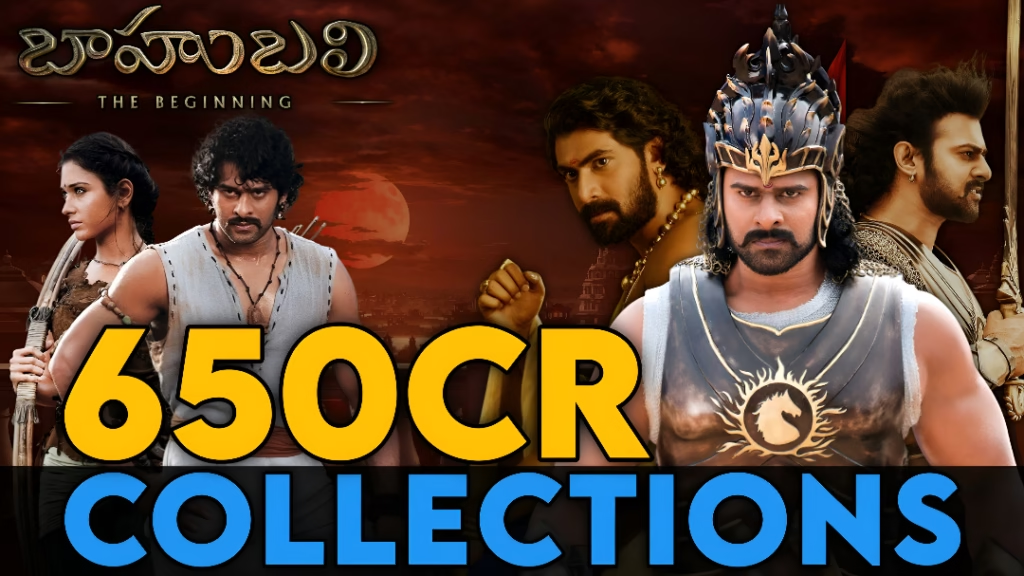
By the end of its theatrical run, Baahubali: The Beginning grossed approximately ₹650 crore worldwide, including around ₹516 crore from India and nearly ₹134 crore from overseas markets, making it one of the biggest blockbusters in Indian cinema history at the time.
⭐ Box Office Summary (Quick View)
- 🇮🇳 India Gross: ₹516 Cr
- 🌐 Overseas Gross: ₹134 Cr
- 🌏 Worldwide Gross: ₹650 Cr
Plot
An injured woman named Shivagami Devi escapes through a cave beneath a massive waterfall while carrying a baby. As she struggles to cross a raging river, she is swept away by the current. Before dying, she raises the child above the water and prays for his safety. The baby is rescued by the people of the Amburi tribe, and their leader’s wife, Sanga, adopts him and names him Sivudu.
Sivudu grows up as a strong and adventurous young man, constantly dreaming of climbing the giant waterfall despite his mother’s warnings. One day, he discovers a mysterious mask that falls from above, inspiring him to find its owner. After finally climbing the waterfall, he meets Avantika, a fierce warrior belonging to a rebel group trying to rescue Devasena, a captive princess held by the cruel ruler Bhallaladeva of Mahishmati.
Determined to help Avantika, Sivudu travels to Mahishmati and enters the kingdom during a grand celebration. There, he saves many people from danger and attracts attention when slaves begin calling him Baahubali. That same night, he rescues Devasena and escapes, but Bhallaladeva’s forces chase him. During the battle, Sivudu kills Bhallaladeva’s son Bhadra. Seeing this, the loyal warrior Kattappa bows before Sivudu and reveals that he is actually Mahendra Baahubali, the son of the legendary prince Amarendra Baahubali.
Kattappa then narrates the past. Decades earlier, after the death of King Vikramadeva, Queen Regent Sivagami raised two princes — Amarendra Baahubali and Bhallaladeva — deciding that the more worthy one would become king. While Bhallaladeva grows ambitious and power-hungry, Baahubali earns the love and respect of the people through his courage and compassion.
When the kingdom faces invasion from the brutal Kalakeya tribe, both princes lead the army into battle. Baahubali shows strategic brilliance and protects civilians, while Bhallaladeva focuses only on destruction. Though Bhallaladeva kills the enemy leader, Sivagami chooses Baahubali as the future king because of his leadership and humanity, leaving Bhallaladeva disappointed.
Back in the present, Sivudu is shocked to learn that his father Amarendra Baahubali was betrayed and murdered. When he demands to know who killed him, Kattappa reveals the shocking truth — he himself was the one who killed Baahubali.
Cast
- Prabhas in a triple role as:
- Mahendra Baahubali (Sivudu / Sivu), the son of Amarendra Baahubali
- Amarendra Baahubali, the legendary prince of Mahishmati
- Maharaja Veerendra Vikramadeva (photo appearance), the former king
- Sathvik Varma as young Sivudu
- Nikhil Devadula as young Amarendra Baahubali
- Rana Daggubati as Bhallaladeva (Palvaalthevan in Tamil version)
- Anushka Shetty as Devasena (voiced by Sowmya Sharma)
- Tamannaah Bhatia as Avanthika
- Nassar as Bijjaladeva (Pingalathevan in Tamil)
- Sathyaraj as Karikala Kattappa (voice by P. Ravi Shankar)
- Ramya Krishna as Sivagami Devi
- Venkat Prasad as Sivudu’s foster father
- Rohini Molleti as Sanga, Sivudu’s foster mother and Amburi tribe leader
- Meka Ramakrishna as Jaya Varma, Devasena’s brother and rebel leader
- Tanikella Bharani as Swamiji, a spiritual leader of the Amburi tribe
- Adivi Sesh as Bhadrudu (Bhadra in Tamil), Bhallaladeva’s adoptive son
- Prabhakar as the King of Kalakeyas
- Teja Kakumanu as Saketudu, a traitor who leaks information to enemies
- Sudeepa as Aslam Khan, an Arabian weapons dealer
- John Kokken as a Kalakeya warrior
- Rakesh Varre as Sethupathi
- Chalapathi Rao as a priest
- Scarlett Mellish Wilson as dancer in the song Manohari
- Nora Fatehi as dancer in Manohari
- Warina Hussain as dancer in Manohari
- S. S. Rajamouli in a cameo appearance as a spirit seller
Production
Background and Inspiration
Director S. S. Rajamouli has often said that his childhood love for Indian mythology and comics like Amar Chitra Katha inspired the idea behind Baahubali. Fascinated by stories of kings, battles, and ancient forts, he developed a passion for large-scale storytelling from a young age. This early influence eventually shaped the grand vision of the film.
Baahubali: The Beginning was produced in the Telugu film industry and simultaneously shot in Telugu and Tamil languages. Certain long-distance shots were filmed in Telugu and later dubbed for Tamil audiences. At the time of its release, the film series was considered one of the most expensive projects in Indian cinema.
Development
Rajamouli revealed that the film draws inspiration from Indian epics such as the Mahabharata. The story was written by V. Vijayendra Prasad, who based several characters on mythological influences — for example, Sivagami reflects qualities of Kunti and Kaikeyi, while Devasena resembles a warrior-like version of Sita. The storytelling style was also inspired by classic Indian comics and folklore.
The project was announced in 2011 with Prabhas in the lead role, and the title Baahubali was officially revealed in 2013
More than 90% of the film contained visually enhanced shots. Over 600 VFX artists from multiple studios worldwide contributed to the project. Cinematographer K. K. Senthil Kumar shot the film using Arri Alexa XT cameras, marking Rajamouli’s first major project using digital filmmaking technology.
Technical Production
The movie was primarily filmed in ArriRaw format to achieve high visual quality, especially for scenes involving visual effects. Production designer Sabu Cyril created thousands of weapons, armour pieces, and props. Lightweight materials such as carbon fibre and flexi foam were used to make costumes practical for action sequences. Advanced techniques like 3D printing were used to build large structures, including the giant statue seen in the film.
The technical crew included V. Srinivas Mohan as VFX supervisor, Kotagiri Venkateswara Rao as editor, P. M. Satheesh as sound designer, and Peter Hein as action choreographer. Costume design was handled by Rama Rajamouli and Prasanthi Tipirneni.
Visual Effects
Firefly Creative Studio, Tau Films, Prasad EFX, Srushti VFX, and Annapurna Studios contributed to various sequences including war scenes, underwater shots, and digital character enhancements. The production also used advanced colour and storage workflows to manage the film’s large-scale digital content.
Kiliki Language
A fictional language called Kiliki was specially created for the Kalakeya tribe by linguist Madhan Karky. The language was designed to sound aggressive and unique while remaining easy to learn. It contains hundreds of words and structured grammar rules, making it one of the first fully developed fictional languages created for an Indian film.
Music
The film’s music and background score were composed by M. M. Keeravani, while sound supervision was handled by Kalyani Malik. The soundtrack albums were released in multiple languages, with the Telugu version launching first, followed by Tamil, Hindi, and Malayalam releases.

Release
Theatrical Release
Baahubali: The Beginning was released theatrically on 10 July 2015 in Telugu and Tamil languages, with dubbed versions released in Hindi and Malayalam. The film opened on a massive scale across India and internationally, marking one of the widest releases for an Indian film at that time. It was launched simultaneously in multiple countries to target both domestic and overseas audiences.
The makers planned a multilingual release strategy to expand the film’s reach beyond regional cinema. Due to strong pre-release buzz and large-scale promotions, the film received a grand opening in theatres and quickly gained attention for its visual scale and storytelling.
International Release
The film was distributed in several overseas markets including the United States, United Kingdom, Middle East, and parts of Asia. It also reached countries in Southeast Asia and other international territories through regional distributors. This wide international rollout helped the film gain global recognition and introduced Telugu cinema to a broader audience.
Dubbed Versions
Along with the original Telugu and Tamil versions, dubbed versions in Hindi and Malayalam were released to cater to wider Indian audiences. The Hindi version, presented by Dharma Productions, played a major role in making the film popular across North India and contributed significantly to its national success.
Distribution
Before the release of Baahubali: The Beginning, distribution rights were sold across different regions and languages. In July 2014, the Karnataka and Ceded (Rayalaseema) regional rights were reportedly sold for a significant amount. Producer Dil Raju later confirmed that he had acquired the Nizam distribution rights for the first film and planned to secure rights for the sequel as well.
The film was presented by different distributors depending on the language version. The Telugu version was backed by K. Raghavendra Rao, while the Tamil version was handled by K. E. Gnanavel Raja along with Sri Thenandal Films and UV Creations. The Hindi version was presented by Karan Johar, helping the film reach a wider North Indian audience.
International distribution was also planned on a large scale. The movie was released across several Asian countries including Thailand, Vietnam, Laos, Cambodia, Myanmar, and Timor-Leste. Separate distribution deals were made for regions such as Latin America, Taiwan, and South Korea through different entertainment companies, expanding the film’s global reach.
Controversy
The Tamil version of the film faced controversy after its release due to the use of a particular word in the dialogue. Certain activist groups claimed that the term was offensive and carried caste-based connotations. Protests were held in some areas, including an incident outside a theatre in Madurai.
Following the criticism, the dialogue writer of the Tamil version, Madhan Karky, issued a public apology, stating that there was no intention to hurt any community and expressing regret for the misunderstanding.
Home Media
The satellite television rights of the film were sold to different channels depending on language versions. Star Maa acquired the Telugu version, while the Malayalam version was licensed to Mazhavil Manorama. Jaya TV received the Tamil version, and Colors Kannada obtained the Kannada dubbed rights. The Hindi dubbed version was acquired by Sony Max, with additional dubbed versions later broadcast on regional channels in Odia, Bhojpuri, Marathi, and Bengali.
For digital streaming, Netflix acquired the online rights for all language versions, allowing the film to reach a global audience through streaming platforms.
Reception
Critical response
Baahubali: The Beginning received largely positive reviews from critics. On the review aggregator Rotten Tomatoes, the film holds an approval rating of 91% based on critic reviews, with an average rating of around 7.1/10. Critics mainly praised the film’s масштаб (scale), visual presentation, and epic storytelling style.
India
Indian critics responded positively to the film’s grand execution, action choreography, and technical quality. Many reviewers appreciated director S. S. Rajamouli for creating a visually rich cinematic world and delivering large-scale battle sequences rarely seen in Indian cinema at that time.
Several major publications gave strong ratings.
- NDTV rated the film 3/5 stars, praising its magical universe and larger-than-life characters.
- Rediff gave the film 4/5 stars, calling it ambitious and visually impressive.
- Filmfare also rated it 4/5, describing it as an epic theatrical experience despite minor storytelling flaws.
- India Today praised the film’s scale and action while noting that viewers should enjoy it as a fantasy spectacle rather than focus on realism.
Critics especially highlighted the second half and the long war sequence, considering it one of the biggest action set pieces in Indian cinema. The performances of the lead cast, cinematography, visual effects, and music were widely appreciated, though a few reviewers mentioned pacing and screenplay issues.
International
International critics gave the film positive to mixed reviews, with many appreciating its ambition and visual storytelling. Reviewers from publications such as The Hollywood Reporter, Screen Daily, and The Guardian praised the film’s epic scale, action design, and entertainment value.
Some critics felt the storytelling followed familiar mythological patterns, but they still acknowledged the film’s energy and strong direction. Overall, international reviews recognized Baahubali: The Beginning as a bold cinematic achievement that introduced large-scale Indian fantasy filmmaking to global audiences.
Awards
Baahubali: The Beginning received widespread recognition and won several prestigious awards for its cinematic achievement, technical excellence, and performances. At the 63rd National Film Awards, the film won the Best Feature Film award, becoming the first Telugu film in history to receive this honour. It also won the award for Best Special Effects, highlighting the film’s groundbreaking visual work.
At the 63rd Filmfare Awards South, the Telugu version achieved major success by winning five awards out of ten nominations. The film secured important categories such as Best Film, Best Director for S. S. Rajamouli, and Best Supporting Actress for Ramya Krishna, among others.
The film also performed strongly at the 1st IIFA Utsavam, where both the Telugu and Tamil versions won multiple awards in their respective categories, including recognition for Best Film and Best Director. The performances and technical aspects of the film were widely appreciated across regional award platforms.
Internationally, Baahubali: The Beginning made history by becoming the first Indian film to receive nominations at the Saturn Awards. At the 42nd Saturn Awards, the film earned five nominations, including categories such as Best Fantasy Film and Best Supporting Actress for Tamannaah Bhatia, further proving its global impact and recognition.
Legacy
Baahubali: The Beginning became an important milestone in Indian cinema and was even featured in the BBC documentary celebrating 100 Years of Indian Cinema, directed by Sanjeev Bhaskar. The massive success of the film helped popularize the idea of “Pan-Indian” cinema, where movies are released and accepted across multiple languages and regions in India.
The film’s influence could also be seen in other movies and media. In 2016, actor Thagubothu Ramesh portrayed a character named Kattappa in the film Selfie Raja, inspired by the iconic character from Baahubali. Later, in 2017, a Tamil film titled Kattappava Kanom (meaning “Kattappa is Missing”) was released, showing how deeply the character had entered popular culture.
In 2018, Netflix announced a streaming prequel series titled Baahubali: Before the Beginning, expanding the story’s universe beyond the films. The cultural impact of the franchise continued as references to Kattappa appeared in other films as well, including a scene in Kanaa (2018), where actor Sathyaraj — who played Kattappa — was acknowledged through a dialogue reference.

EXTERNAL LINKS
WIKIPEDIA :- https://en.wikipedia.org/wiki/Baahubali:_The_Beginning#
IMDB :- https://www.imdb.com/title/tt2631186
INTERNAL LINKS
S.S.RAJAMOULI :- https://cinemaatlas.com/ss-rajamouli-all-movies-list/
Baahubali: The Beginning :-
1.What is the runtime of Baahubali: The Beginning?
The movie has a total running time of 2 hours and 39 minutes.
2.When was Baahubali: The Beginning released in theatres?
The film was officially released on July 9, 2015.
3.Who are the lead actors in Baahubali: The Beginning?
The main cast includes Prabhas, Rana Daggubati, and Anushka Shetty.
4.What is the IMDb rating of Baahubali: The Beginning?
The film holds an IMDb rating of 8/10.
5.Who wrote the story and screenplay of Baahubali: The Beginning?
The film was written by S.S. Rajamouli, Vijayendra Prasad, Manoj Muntashir, Mankombu Gopalakrishnan, Ajay Kumar, C.H. Vijay Kumar, and Madhan Karky.
6.Who directed Baahubali: The Beginning?
The movie was directed by S.S. Rajamouli.
7.Who composed the music for Baahubali: The Beginning?
The music and background score were composed by M.M. Keeravani.
8.Who produced Baahubali: The Beginning?
The film was produced by Shobu Yarlagadda and Prasad Devineni.
9.Who served as the executive producers of the film?
The executive producers were K. Raghavendra Rao and Surendra.
10.Who handled the cinematography of Baahubali: The Beginning?
The cinematography was done by K.K. Senthil Kumar.
11.Who edited Baahubali: The Beginning?
The film was edited by Kotagiri Venkateshwara Rao.
12.Which main characters appear in the movie?
Key characters include Baahubali, Shivudu, Bhallaladeva, Devasena, Avanthika, Kattappa, Sivagami, and Bijjaladeva.
13.What is the story of Baahubali: The Beginning about?
The story follows a young man raised by tribal people who later discovers his royal roots and learns about his father’s legacy while fighting to reclaim his kingdom.
14.What was the production budget of Baahubali: The Beginning?
The estimated budget of the film was around $18.03 million.
15.What was the production budget of Baahubali: The Beginning?
The estimated budget of the film was around $18.03 million.
16.How much did Baahubali: The Beginning earn worldwide?
The movie earned approximately $24.5 million at the global box office.
17.How much was the US box office collection?
The film collected about $6.74 million in the United States.
18.What is the certification or rating of the film?
The movie is listed as Not Rated.