K. V. Reddy – The Filmmaker Who Changed Telugu Cinema Forever
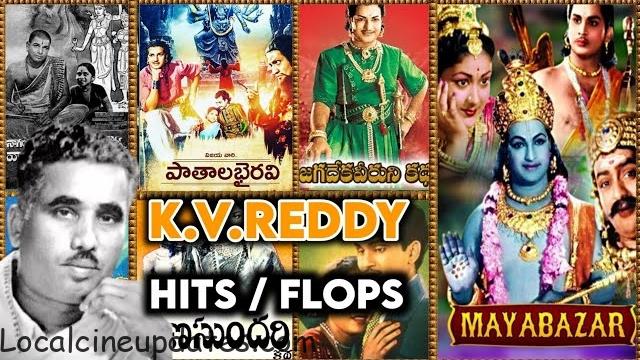
K. V. Reddy is one of the most legendary filmmakers in the history of Telugu cinema, known for directing 14 films without a single flop—an extraordinary achievement even by today’s standards. His filmography includes 4 Industry Hits, 7 Super Hits, 2 Blockbusters, and 1 Hit, making him a benchmark of success in Indian cinema.
He played a crucial role in shaping the stardom of Sr. NTR, with the iconic classic Pathala Bhairavi standing as a milestone in Telugu film history. Renowned for his grand storytelling, strong characterizations, and timeless visuals, K. V. Reddy’s films continue to inspire generations.
Modern-day directors like S. S. Rajamouli, Trivikram Srinivas, and Sukumar have often cited K. V. Reddy as a major influence, highlighting his lasting impact on Telugu cinema and Indian filmmaking as a whole.
K.V.REDDY

K.V.REDDY
Kadiri Venkata Reddy, popularly known as K. V. Reddy, was one of the greatest filmmakers Telugu cinema has ever seen. Born on 1 July 1912, he worked as a director, screenwriter, and producer, and directed 14 iconic films that left a permanent mark on Indian cinema. His extraordinary talent earned him three National Film Awards and a Filmfare Award South.
K. V. Reddy was a master of storytelling, especially known for mythological, fantasy, historical, and drama films. Legendary classics like Mayabazar, Pathala Bhairavi, Jagadeka Veeruni Katha, and Sri Krishnarjuna Yuddhamu are still remembered as golden milestones of Telugu cinema. His films combined strong emotions, grand visuals, and unforgettable characters.
Pathala Bhairavi created history by becoming the only South Indian film screened at the first International Film Festival of India in 1952. Donga Ramudu was later included in the FTII curriculum, proving the artistic depth of his work. Among all his films, Mayabazar is widely celebrated as one of the greatest Indian films ever made, even being voted as the greatest Indian film of all time in a public poll.
Even decades later, K. V. Reddy’s films continue to inspire filmmakers and audiences alike, making him a true pioneer and eternal legend of Telugu cinema.
K.V.REDDY DIRECTED MOVIES
| S.No | Movie Name | Release Year | Verdict |
|---|---|---|---|
| 1 | భక్త పోతన | 1942 | Industry Hit |
| 2 | యోగి వేమన | 1942 | Super Hit |
| 3 | గుణసుందరి కథ | 1949 | Industry Hit |
| 4 | పాతాళ భైరవి | 1951 | Industry Hit |
| 5 | పెద్దమనుషులు | 1954 | Super Hit |
| 6 | దొంగ రాముడు | 1955 | Super Hit |
| 7 | మాయాబజార్ | 1957 | Industry Hit |
| 8 | పెళ్ళినాటి ప్రమాణాలు | 1958 | Super Hit |
| 9 | జగదేక వీరుని కథ | 1961 | Blockbuster |
| 10 | శ్రీ కృష్ణార్జున యుద్ధము | 1963 | Super Hit |
| 11 | సత్యహరశ్చంద్ర | 1965 | Blockbuster |
| 12 | ఉమ చండి గౌరి శంకరుల కథ | 1967 | Super Hit |
| 13 | భాగ్యచక్రం | 1968 | Super Hit |
| 14 | శ్రీకృష్ణ సత్య | 1972 | Hit |
Collaborators
K. V. Reddy is noted for his collaboration with writer Pingali which produced many successful films.[9] K. V. Reddy also introduced D. V. Narasaraju, who became a noted screenwriter, into the film industry.[15] He also collaborated with Marcus Bartley on most of his films.[10] Pendyala worked as a music composer for seven of his films, while Ghantasala composed the music for three films. Ogirala Ramachandra Rao and Nagayya composed music for three and two films respectively. Singeetam Srinivasa Rao, who would later become a doyen of South Indian cinema, worked with K. V. Reddy from Donga Ramudu (1955) till Uma Chandi Gowri Sankarula Katha (1968). He initially joined Reddy as an apprentice and later became an assistant director in his team.[17][80]
N. T. Rama Rao collaborated with him on eight of his films. Akkineni Nageswara Rao acted in four films of his. Nagayya played the lead role in K. V. Reddy’s first two films — Bhakta Potana, Yogi Vemana and later played supporting roles in three films. S. V. Ranga Rao acted in three of his films — Pathala Bhairavi, Pellinaati Pramanalu, Sri Krishna Satya. B. Saroja Devi played the female lead in four of his films. Savitri and Jamuna each played the female lead in two of K. V. Reddy’s films.
🏆 Awards & Honours of K. V. Reddy
🎖️ National Film Awards
🏆 Best Feature Film in Telugu – Pedda Manushulu (1955)
🏆 Best Feature Film in Telugu – Pellinaati Pramanalu (1958)
🏆 Best Feature Film in Kannada – Satya Harishchandra (1966)
🎬 Filmfare Awards South
🏆 Best Director (Telugu) – Sri Krishna Satya (1972)
INTERNAL LINKS
SR.NTR :- https://cinemaatlas.com/senior-ntr-directed-films/
SS.RAJAMOULI :- https://cinemaatlas.com/ss-rajamouli-all-movies-list/
EXTERNAL LINKS
K.V.REDDY :- https://en.wikipedia.org/wiki/K._V._Reddy

IMDB :- https://www.imdb.com/name/nm0714762/
1.How many movies did K. V. Reddy direct and were any of them flops?
K. V. Reddy directed 14 feature films between 1942 and 1972, and remarkably not a single film was a flop. His filmography includes Industry Hits, Super Hits, Blockbusters, and Hits, making his record unmatched in Telugu cinema history.
2.Which are the Industry Hit movies directed by K. V. Reddy?
The Industry Hit films directed by K. V. Reddy include Bhakta Potana (1942), Gunasundari Katha (1949), Pathala Bhairavi (1951), and the legendary Mayabazar (1957), which is widely regarded as one of the greatest Indian films ever made.
3.Which K. V. Reddy movies became Blockbusters?
Jagadeka Veeruni Katha (1961) and Satya Harishchandra (1965) emerged as major Blockbusters, showcasing K. V. Reddy’s mastery over mythological and fantasy storytelling.
4.Why is Mayabazar considered the greatest film of K. V. Reddy’s career?
Mayabazar (1957) is considered K. V. Reddy’s finest achievement because of its timeless storytelling, performances, and technical brilliance. It was voted by audiences as the greatest Indian film of all time and continues to influence filmmakers even decades later.
5.What makes K. V. Reddy a legendary director in Telugu cinema?
K. V. Reddy is regarded as a legend for his zero-flop career, grand mythological and fantasy films, introduction of cinematic standards ahead of his time, and for inspiring generations of filmmakers, including modern directors like S. S. Rajamouli